Disclaimer: This post may have affiliate links. As an Amazon Associate, I earn from qualifying purchases.
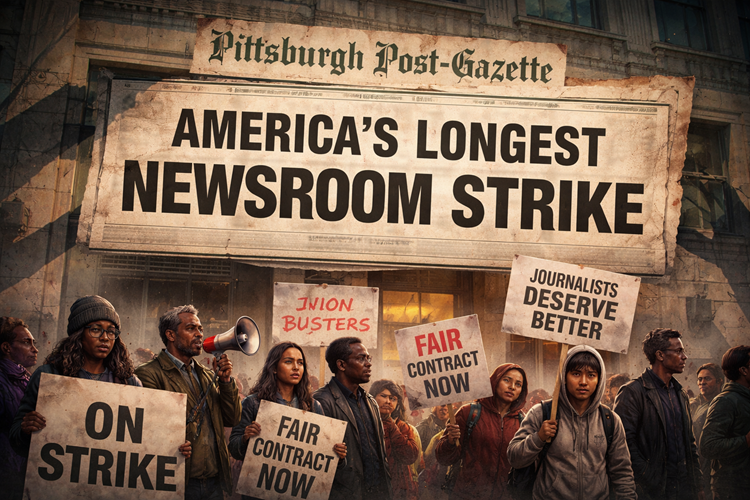
Employee Relations in U.S. Newsrooms; a Survey and an in depth look at a Troubled Newsroom.
U.S. newsrooms have been battered by years of collapsing advertising revenue, consolidation and cost‑cutting. Layoffs, stalled contract negotiations and fights over modern technology (notably AI) have fostered tense employee relations and a wave of union organizing. During 2024–26 several major newsrooms saw mass layoffs or high‑profile labor disputes, but one newsroom stood out for sustained hostility toward its workers. This report surveys several notable cases and explains why the Pittsburgh Post‑Gazette is widely regarded as having the worst employee relations in U.S. journalism.
Cases of significant newsroom labor conflict
Los Angeles Times - layoffs and seniority disputes
The Los Angeles Times, owned by billionaire Patrick Soon‑Shiong, announced in January 2024 that 115 newsroom employees (more than 20 % of the staff) would be laid off. The layoffs later climbed to about 120 people. The paper’s union said 63 of the 94 guild members laid off belonged to its Black, Latino, Asian American and Middle Eastern caucuses, illustrating how prioritizing seniority to decide layoffs disproportionately affected journalists of color. Management insisted that seniority rules forced those outcomes, while the union argued that leaders refused to offer sufficient buyouts to limit layoffs. The guild staged a one‑day work stoppage, the first in the paper’s 142‑year history to protest the cuts and demand clarity on the number of jobs being eliminated.
ProPublica - AI protections and just‑cause demands
In March 2026, the ProPublica Guild (about 150 journalists, videographers and development staff) voted 92 % to authorize a strike if management refused to address several contract demands. Negotiations had been underway for two and a half years. A principal sticking point was the union’s demand for contract language prohibiting layoffs due to artificial‑intelligence adoption and establishing just‑cause protections during firings. The guild also sought cost‑of‑living raises and a “last‑in, first‑out” framework for layoffs. Management responded that it did not want to lock editorial decisions into a multi‑year contract but proposed expanded severance packages instead. While ProPublica has never had layoffs, the dispute underscores staff anxiety about AI replacing human roles and the need for contract safeguards.
Gannett newspapers - wage floors and AI concerns
Gannett, the nation’s largest newspaper chain, faced open‑ended strikes at several of its local papers in 2024. Reporters at the Austin American‑Statesman and the Rochester Democrat and Chronicle walked off the job in April 2024 after years of bargaining did not yield contracts. The Austin News Guild said Gannett proposed a salary floor of $50 000 and a one‑time raise of 50 cents an hour for higher‑paid employees; the union had demanded a $57 000 floor and tiered raises to keep experienced reporters. Journalists noted that a quarter of their staff had left in the past three years due partly to low pay. The unions also sought protections against layoffs and safeguards against AI displacing jobs. Gannett tried to accelerate negotiations by threatening to void recently bargained provisions if an agreement was not reached. The strikes illustrate growing friction between cost‑conscious corporate owners and reporters seeking living wages and AI assurances.
The Pittsburgh Post‑Gazette - why its employee relations are considered the worst.
While several newsrooms have experienced layoffs or short strikes, the Pittsburgh Post‑Gazette stands apart for the depth and duration of its labor conflict. The paper is owned by Block Communications, a family‑run media company whose current leaders, the Block brothers, took over in the late 1980s.
A multi‑year strike and pervasive labor violations
- Longest strike in U.S. newspaper history: The Post‑Gazette’s editorial staff and production workers went on strike in October 2022, and the work stoppage lasted 1 133 days, ending only on 24 November 2025. By the summer of 2024 it had become the longest ongoing labor action in the country and the longest in the history of American newspapers.
- Working without a contract and zero raises: Before walking out, journalists had worked without a contract for more than three years. During that time, they received no across‑the‑board raises since 2006.
- Unfair labor practices: The strike was triggered by a series of unilateral actions by management:
- In July 2020, the company replaced the union’s health plan with an inferior and more expensive plan without negotiation.
- Management eliminated the guarantee of a 40‑hour work week, abolished the collectively bargained short‑term disability plan, cut paid time off and removed employees’ right to appeal disciplinary actions.
- The union said the new health plan effectively reduced workers’ annual wages by thousands of dollars.
- When bargaining resumed, PG Publishing demanded the right to subcontract union jobs, change work hours and scale back health benefits; it prematurely declared an impasse, imposed wage cuts and surveilled strike rallies.
- Unsafe and abusive environment: In interviews with The Baffler, striking workers described unpredictable scheduling and workplace harassment as endemic in a newsroom that had not seen a general raise since 2006.
- Legal rulings against management: In September 2024, the National Labor Relations Board ruled that the Post‑Gazette had broken federal labor law. In November 2025, the U.S. Court of Appeals for the Third Circuit ordered the paper to restore workers’ rights and compensate them for five years of violations. After the court decision, strikers returned to work, effectively winning back their contract terms.
Human impact and community support
During the three‑year strike, workers picketed, leafleted, and even protested at a private school gala attended by a Block family board member. Strikers relied on a strike fund and solidarity from supporters; many experienced life milestones like marriages, cancer battles, raising children while on the picket line. Community donors contributed more than a million dollars to sustain the strike. Despite the hardship, strikers refused to give up, seeing themselves as part of Pittsburgh’s long tradition of labor activism.
Why the Post‑Gazette’s case is exceptional.
- Scale and duration: The length of the strike and the accumulation of labor violations set the Post‑Gazette apart from other newsrooms. While the L.A. Times and Gannett unions staged brief walkouts and ProPublica’s union vote has not yet resulted in a strike, the Post‑Gazette conflict lasted over three years and required federal court intervention.
- Number and severity of violations: Block Communications removed health care, job protections and basic bargaining rights, actions that federal courts deemed unlawful. Few other newsrooms have faced such a long list of infractions.
- Management hostility: Reporting suggests that the Block family sought the union’s dissolution and refused to negotiate even after a Pulitzer‑winning front page in 2018. Strikers described the owners as willing to sacrifice the paper’s future rather than concede to worker demands.
Conclusion
The journalism industry’s financial challenges have strained employer-employee relations in newsrooms across the United States. Significant disputes have erupted at Gannett papers, ProPublica and the Los Angeles Times, where union members have fought for living wages, fair layoff practices, and protections against AI displacement.
However, the Pittsburgh Post‑Gazette stands out for its extreme and prolonged conflict. Management’s decision to strip workers of healthcare and job protections, impose wage cuts and bargain in bad faith triggered a strike that became the longest in U.S. newspaper history. Federal rulings affirming the workers’ rights suggest that the employer’s actions were not only harsh but illegal. For these reasons, the Post‑Gazette is widely viewed as having the worst employee relations among major U.S. newsrooms during this period.
_________________________________________________________________
ABOUT THE AUTHOR:
Earnest Sherrill is a freelance writer and digital publisher focused on journalism, media ecosystems, and online content strategy. With experience building and managing multiple publishing platforms, they specialize in analyzing industry trends, audience growth, and the evolving relationship between media, technology, and readers.
Authors LaunchPad - Book marketing systems and launch funnels.
Authors Book Launch - Press releases, media kits, and book launch blogs.
8Write - Writing tips and creative development resources.
ArticleDrafts - Prewritten content and ghostwriting services for authors.
MTDLN Media Group - Explore our full creator network.